
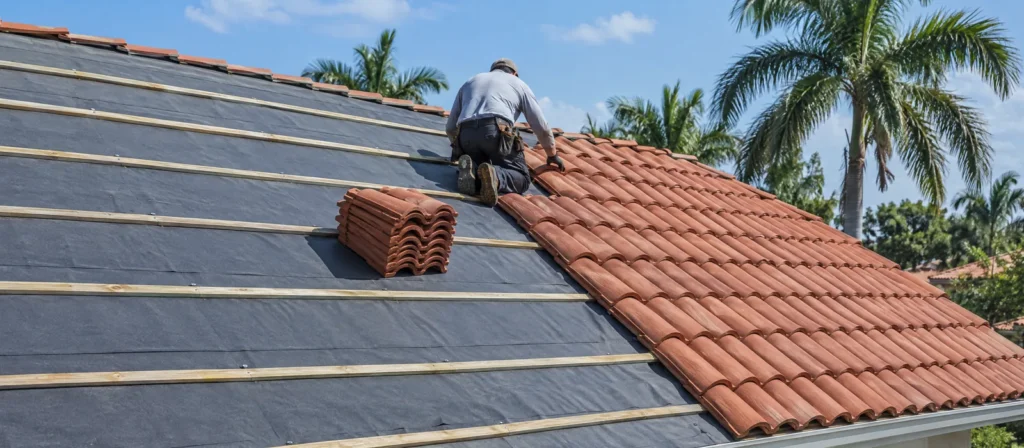
The ceiling stain shows up in a hallway, nowhere near a bathroom or an AC line. The roofer goes up, walks the roof, and comes down with news that doesn’t make sense at first: the tiles are fine. All of them. The roof is leaking anyway.
That roof didn’t fail at the tile. It failed at the tile roof underlayment, the membrane fastened to the deck underneath, and if you own a tile roof in Florida or you’re pricing one, this is the part of the system worth understanding best. The tile is the part you see and the part that lasts. The underlayment is the part that wears out, and it is the line on the quote that decides how long the whole roof goes before someone has to open it up.
What the tile does, and what the membrane does
A tile roof is two systems stacked on top of each other. The tile sheds most of the water, takes the sun, and takes the hits. The underlayment underneath is the actual waterproofing: a continuous membrane over the deck that catches whatever gets past the tile, which in a Florida downpour with wind behind it is never nothing.
The tile also protects the membrane. Underlayment exposed to Florida sun breaks down in months. Shaded under tile, a good membrane lasts decades. That arrangement is why the tiles on a sixty-year-old clay roof can be reusable while the felt under them has turned to something like dry cardboard.
So when a tile roof leaks and the tiles are sound, the underlayment is one of the first places to look, along with the flashing and anything that goes through the roof.
What Florida requires under a tile roof
The Florida Building Code treats the underlayment as a structural part of the system, not an accessory. For tile outside Miami-Dade and Broward, the code points to an installation manual for the underlayment rules, and that manual sets the underlayment system by roof slope and tile system. Flatter roofs drain slower, so on them the membrane carries more of the load.
The FRSA/TRI Florida High Wind Concrete and Clay Tile Installation Manual, the standard the code points to for tile outside the High Velocity Hurricane Zone, goes further. A self-adhered membrane has to pass 90 days of UV exposure testing before it can be used under tile, and mechanically attached underlayment assemblies have to pass wind uplift testing under FM 4474 or UL 1897. The membrane has its own performance tests, because during installation and after a storm strips a tile, it is the roof.
Our own Miami-Dade Notices of Acceptance for Tecno and Plasma say the same thing a different way: the underlayment must comply with the Roofing Application Standards the NOA names. The tile’s approval assumes the right membrane under it. Put an approved tile over the wrong underlayment and you no longer have an approved roof.
Felt then, membranes now
Open up a Florida tile roof from the 1990s and you’ll usually find hot-mopped felt, the 30/90 system, a base sheet with a heavier mineral-surfaced sheet mopped over it in hot asphalt. It was the standard of its day and it did its job.
What we recommend under a new tile roof today is a self-adhered high-temperature membrane, used in an approved assembly. It adheres to the deck rather than relying on nails alone, which means fewer holes in the waterproofing, and it seals around the fasteners that attach the battens and tile above it. The high-temperature rating matters because the underside of tile on a Florida afternoon is an oven, and a membrane rated for it holds its seal there.
The difference between the two isn’t visible from the street and barely visible on the invoice. Ask about it anyway: the membrane is the roof’s actual waterproofing, and how long it lasts depends on the product, the assembly and the installation.
The lift-and-relay, and why it often becomes a new roof
When the underlayment under good tile gives out, the repair has a name: lift and relay. The tile comes off, the old membrane comes off, new membrane goes down, and the tile goes back on.
That is the plan. Here is what happens in practice. A share of the old tile breaks coming up, because tile that has been down for decades does not come up gently. Then someone goes looking for matching replacements and finds the color was discontinued years ago. At that point the owner is choosing between a roof with a mismatched patch and a new roof, and most choose new.
We’d rather you never get there, which is why the underlayment conversation belongs at the start of the roof’s life, not decades in. Underlayment can need replacing while the tiles are still sound, so it is worth specifying carefully from the start.
How to read the underlayment line on a quote
Every tile quote has an underlayment line. Most homeowners skip past it to the total. Read it instead, and ask one question: does this underlayment carry its own product approval, and does it meet the standards the tile’s approval names?
A roofer working from the approval can answer in a sentence. A quote that just says “felt” or “synthetic” with no product name is a quote that hasn’t decided yet, and whatever gets decided later will not be decided in your favor. The upgrade from a basic sheet to a self-adhered high-temperature membrane is one of the smallest numbers on the page relative to what it buys, and it is the first thing we’d change on almost any thin quote.
If you want the rest of the picture, our post on how long tile roofs last in Florida covers what else sets a tile roof’s lifespan, and the cost guide covers where the underlayment sits in the overall price.
You can request a Tecno or Plasma sample from us, or find a contractor who has installed them.
Questions people ask
How long does underlayment last under a tile roof?
It depends on the product and the installation, and nobody should hand you a number without knowing both. What you control is the spec, and the one we would ask for is a self-adhered high-temperature membrane with its own product approval.
Do I need two layers of underlayment?
It depends on the system. Outside Miami-Dade and Broward, the Florida Building Code points to the FRSA/TRI installation manual for tile, which lists underlayment systems by roof slope; some are two layers and some are a single self-adhered membrane. That is one more reason the quote should name the system, not just the material.
Can underlayment be replaced without replacing the tile?
Yes, that is the lift-and-relay described above. Whether it makes sense depends on how much of the tile survives removal and whether the color is still made. It is a real option, and it goes better when the roof was documented when it was built.