
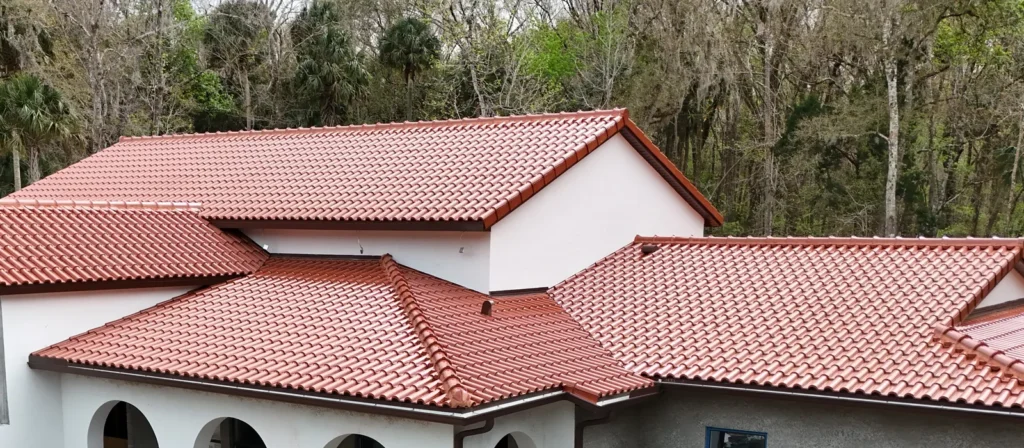
Three roofers look at the same house and the three numbers that come back are thousands of dollars apart. None of the quotes explains why, and the national cost guides you find afterward are no help, because they average Arizona and Ohio into a number that fits neither, let alone a Florida roof that has to be built for hurricane wind.
Here is the real answer on clay tile roof cost, from the people who supply the tile. In Florida, expect $1,300 and up per square, installed. A square is roofing’s unit: 100 square feet of roof surface, so that is $13 and up per square foot. The “and up” is doing work in that sentence, and the rest of this post explains exactly what pushes a roof above the floor, so you can look at your own house and see which of it applies.
First, a rough budget in one paragraph. Your roof is bigger than your floor plan. Pitch, overhangs, and the garage all add surface over the same footprint, so a usable rule of thumb is to multiply your interior square footage by 1.5 to 2. A 2,000 square foot house carries roughly 3,000 to 4,000 square feet of roof, which is 30 to 40 squares, which at the floor price is $39,000 to $52,000 and up. That is a planning number, not a quote. A steep roof with deep overhangs and a three-car garage lands at the top of the multiplier; a simple low-slope rectangle lands at the bottom.
What the roof itself adds
Before anyone talks about tile, the shape and position of your roof sets part of the price.
Access is the quiet one. A house where the truck, the crane, and the dumpster can get close costs less to roof than the same house behind gates, pools, and landscaping that everything must be carried around. Slope and pitch are next: a steeper roof is slower and requires more safety setup, and every hour of that is on the sheet. Height does the same thing. A single-story ranch and a three-story coastal block house might carry the same square count and very different labor numbers, because on the tall one every tile travels further and every worker moves slower.
Then there’s what’s coming off. Tear-off is priced by what the old roof is and how many layers of it there are. Stripping one layer of shingles is the easy case. An old tile or built-up roof costs more to remove and dispose of, and what the tear-off reveals, the condition of the deck underneath, is the one genuinely unknowable line until the roof is open.
What the system choices add
The second group of factors is choices, which means they’re the part you control.
Whether the tile is an interlocking clay matters. Interlocking tiles like Tecno and Plasma lock into their neighbors on the sides and head, which changes how they’re laid and how the roof performs in wind. How the tile is attached matters too: foam adhesive only, fasteners only, or a hybrid of both. Each is a different combination of material and labor, and the right one for your roof comes out of the product approval and your wind zone, not out of preference. It is a cost line and an engineering line at the same time, which is why it should be named on the quote rather than left as “installation.”
Finish is on the list too: glazed and natural are priced differently, and the quote should say which you are getting. And then there is the underlayment, the membrane under the tile that does the actual waterproofing. It is one of the smaller numbers on the page and the one that most decides how long the roof goes before anyone opens it again. We wrote a separate post on underlayment because it deserves one; the short version for the quote is that a self-adhered high-temperature membrane is the spec to look for.
The Florida part of the bill
Some of the price is Florida itself. Outside Miami-Dade and Broward, tile systems install to the FRSA/TRI Florida High Wind Concrete and Clay Tile Installation Manual. Inside them, the High Velocity Hurricane Zone, the system has to carry a product approval for HVHZ use, such as a Miami-Dade Notice of Acceptance. Fastening schedules that hold a roof together at hurricane wind speeds take more hardware and more labor than the same roof would get in a calm state. The underlayment system is chosen to match the roof’s slope and tile, from the FRSA/TRI manual or, in the HVHZ, the standards the approval names, so two roofs with the same tile can carry different underlayment lines.
A real tile roof is also more than field tile. The ridges, hips, rakes, and eaves are finished with fitting pieces made for the tile, and a quote that itemizes fittings is describing a finished roof, while one that doesn’t is describing a field of tile with decisions deferred.
None of this is padding. It is the difference between a roof priced to pass inspection and one priced to pass the next twenty hurricane seasons.
What the price buys, measured in decades
Judged on the installed price alone, clay sits in the same bracket as standing seam metal, above shingles and concrete tile. Judged per year of service, the order changes. A shingle roof in Florida is a roof you buy more than once, each time with its own tear-off, permit, and disruption, and a concrete tile roof keeps its structure longer than it keeps its color. Fired clay keeps both. The color goes through the kiln with the tile, so the roof you pay for in year one is the roof the street sees in year thirty.
That is the honest frame for the $1,300 floor: it is the entry price of the last roof, not the cheapest roof. Our materials comparison walks the four material families through that math side by side.
Getting a quote you can trust
Three things turn a vague tile quote into a real one. The underlayment line names the product and its approval. The attachment method is stated: foam, fasteners, or hybrid. The fittings are itemized. A roofer who gives you those three has thought about your roof; a roofer who gives you one number has thought about your zip code.
You can request a Tecno or Plasma sample from us before any of that starts, or find a contractor who has installed them.
Questions people ask
What does a clay tile roof cost per square foot in Florida?
From $13 per square foot installed, which is the $1,300-per-square floor stated above. Access, slope, height, tear-off, attachment method, finish, and underlayment move it up from there.
Why are my quotes so far apart?
Usually because they aren’t describing the same roof. Check the three lines named above: underlayment, attachment, and fittings. The cheap quote is often missing one of them, which means it comes back as a change order later.
Is clay tile more expensive than metal?
Installed, the two sit in the same bracket. The comparison worth making is what each looks like decades in, and clay’s answer is that it looks the way it did when it went on.