
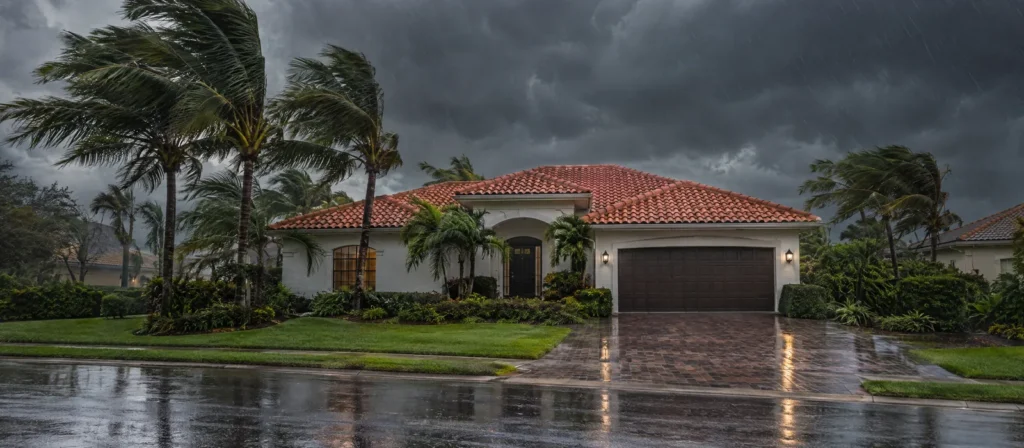
We get a version of the same question every June, usually from someone who has already fallen for the look of the tile: we love it, but this is Florida. What they’re really asking is what happens to a clay tile roof in a hurricane, and they deserve a better answer than a brochure word like “durable.”
So here is the better answer. No roof is hurricane proof, ours included, and anyone who tells you otherwise is selling something other than roofing. What a roof can be is tested, engineered for your specific wind zone, and designed so that when a storm does take its toll, the toll is a repair instead of a replacement. That is the standard clay tile is held to in this state, and the rest of this post walks through the evidence, most of which is public.
What hurricane wind actually does to a roof
Hurricane wind doesn’t push a roof down. It pries it up. Moving air builds pressure differences across the roof surface, strongest at the corners, edges, and ridge, and those differences work on every tile, shingle, and panel like a thumb under a lid. Once the first piece lifts, the storm has an opening and a handle, and the rest goes by the row.
So the engineering question for any roofing material is not “how strong is it” in the abstract. It is: how hard is each piece to pry up, and what is it attached to.
Clay tile brings two answers. The first is mass: a Tecno tile weighs 8.6 pounds on its Miami-Dade Notice of Acceptance, and a Plasma tile 8.9, which is a different starting point for a gust than a lightweight shingle. The second is the interlock. Tecno and Plasma lock to their neighbors along the sides and head, so wind trying to lift one tile is fighting the tiles around it, not a single piece alone.
Neither of those is left as a talking point. On the NOA, the attachment tables are written as a moment-based system under RAS 127: every tile’s resistance to being rotated and pried up is calculated against your roof’s wind zone, height, and position on the roof, with the corners and edges treated as their own, harsher case. That is why nobody honest quotes you one wind-speed number for a tile. The number is engineered per roof, and the calculation is part of the permit, not the marketing.
The testing behind the approval
Tecno and Plasma each carry a current Miami-Dade Notice of Acceptance, NOA 25-0410.06 and 25-0410.05, both valid through June 1, 2028, which means the systems are approved for use in the High Velocity Hurricane Zone, the two counties, Miami-Dade and Broward, with the strictest wind requirements in the Florida Building Code. Outside Miami-Dade, an NOA can be used wherever the local building department accepts it, so the tile has already cleared the strictest bar in the state.
Getting an NOA means the tile went through Miami-Dade’s own test protocols, and they are listed on the document: TAS 101 and TAS 102 for uplift resistance, and TAS 100 for wind-driven rain. That last one deserves a sentence, because it is the test most buyers have never heard of and the one that matches what a hurricane actually does. A hurricane doesn’t drop rain on your roof. It drives rain at your roof, horizontally, for hours, and TAS 100 is the protocol that simulates exactly that against the assembled system.
Both NOAs are public documents, posted on our resources page and in Miami-Dade’s own database. We’d encourage you to ask for the equivalent paperwork from anyone quoting you any roof.
The impact question
Wind is half the storm. The other half is what the wind carries, and this is where the material itself gets tested rather than the attachment.
In strength testing, a CS clay tile carried roughly 970 pounds of load before giving way. Comparable concrete tile gave way at roughly 140. Hold those two numbers next to each other for a moment, because they are the difference between two materials that look identical on a sample board. Nearly seven times the strength, from the material a buyer is usually told is the same thing in a different color.
And here is the honest part, stated plainly: a hard enough hit will still crack a tile, usually a cut piece at a hip or rake. The same hit goes through a shingle roof and dents a metal one. The difference is what happens next. A cracked tile is a repair, a handful of pieces swapped by someone who knows how to walk a tile roof. A stripped shingle field is a tarp, an insurance claim, and a tear-off. Our materials comparison runs that logic across all four material families.
The quiet parts of the system
Two components do their best work during a storm without ever being seen.
The underlayment is the backstop. If wind-driven rain gets past the tile, or a tile cracks and waits a week for repair, the membrane on the deck is what keeps the water out of your ceiling. The NOAs require underlayment complying with the named Roofing Application Standards, and the spec on that line of your quote matters more in a hurricane state than anywhere else. We wrote a full post on it.
The fittings are the perimeter. Ridges, hips, rakes, and eaves are where wind pries hardest, and on a proper tile roof those are finished in fitting pieces secured per the approval, not improvised in mortar and caulk. A quote that itemizes the fittings is describing a roof built for the week the wind comes.
After the storm
When a storm has passed, get the roof inspected by someone who works on tile, and keep everyone else off it; more tile breaks under untrained boots after a storm than during one. Cracked pieces get swapped. If you kept spare tiles from the installation, this is the day they were for, and it is worth asking your installer to leave you a bundle.
One more quiet benefit for a Florida homeowner: on the state’s wind mitigation inspection form, the roof covering question asks whether the covering has an FBC or Miami-Dade product approval, which can count toward insurance discounts. A tile roof installed to its NOA, with the permit and approval paperwork on file, gives the inspector what that question asks for.
You can request a Tecno or Plasma sample from us, or find a contractor who has installed them.
Questions people ask
What wind speed can a clay tile roof withstand?
There is no single honest number, because the resistance is engineered per roof. The NOA’s attachment tables are calculated for your wind zone, roof height, and the position of each tile under RAS 127, which is exactly how a hurricane-state approval should work. Be wary of any roof sold on one round number.
Are clay tile roofs hurricane proof?
No roof is. Tile’s case is that it is tested for uplift and wind-driven rain under Miami-Dade’s protocols, approved for the strictest wind zone in the Florida Building Code, and built so that storm damage is usually a repair rather than a replacement.
What should I do to my tile roof before hurricane season?
Have it inspected by a tile contractor, replace any cracked pieces, make sure the ridge and hip fittings are secure, and confirm you have spare tiles on hand. While they are up there, have them check the vents, flashing and other roof penetrations too.