
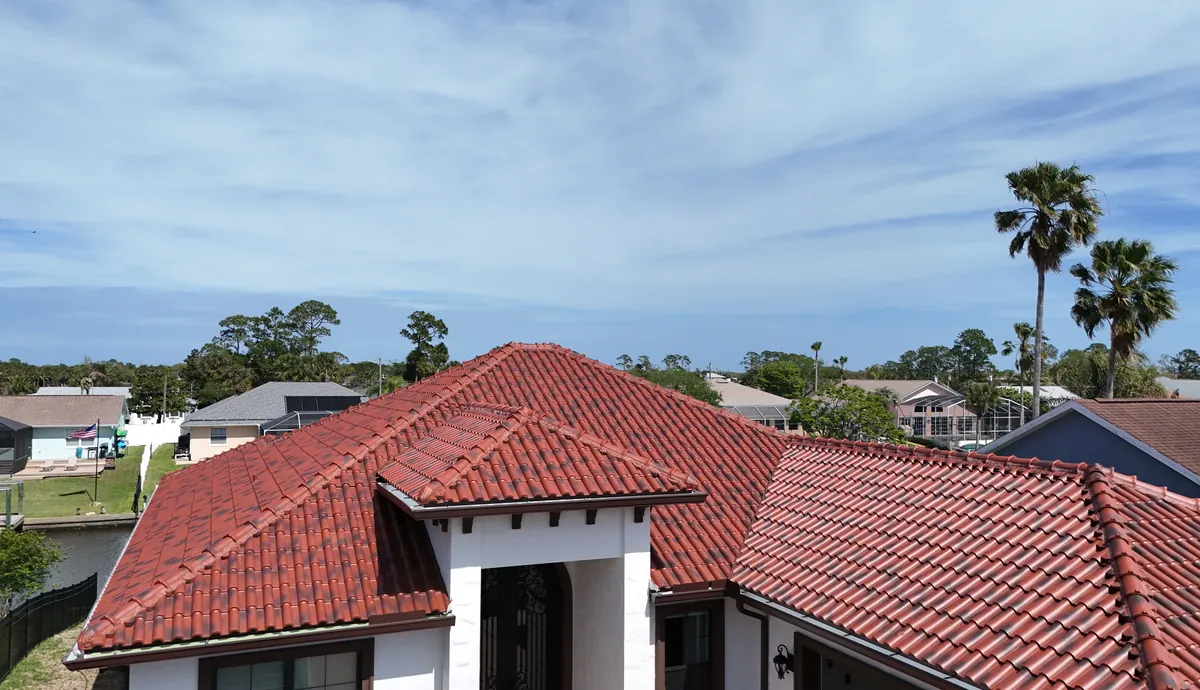
Two tile quotes come back for the same house. From the driveway, the sample boards look almost identical: same barrel profile, similar color, similar heft when you pick one up. One line item says concrete tile. The other says clay tile. The rest of the paperwork, the underlayment, the flashing, the permit, is word for word the same.
The clay vs concrete roof tiles question has a real answer. The two are made differently, they age differently, and the one that looks the same on installation day does not look the same at twenty years. We make clay, so you know which way we lean. Here is the case, with the concrete side stated fairly.
How each one is made
Concrete tile is portland cement, sand, and water, extruded onto a mold and cured until it reaches strength. Eagle Roofing’s own ICC evaluation report describes its tile that way. Color comes from mineral oxides either mixed into the batch before extrusion, called through-color, or applied to the surface afterward as a slurry, a thin layer of pigment, cement, and fine sand over a tile that is otherwise gray.
Clay tile is clay, shaped and then fired in a kiln. No cement, no curing. The heat vitrifies the body, and the color is whatever the clay turns in the fire, or an engobe, a mineral coating, fired on with it. A natural red Tecno tile is red because that is what that clay does at temperature. Nothing was put on top.
Color
Through-color concrete lightens as the surface weathers. Slurry-coated concrete fades faster, because the color is only a skin over gray cement, and once the skin wears through you see the gray. The Florida Roofing and Sheet Metal Contractors Association describes slurry as a coating applied after extrusion over a tile that most often has no color of its own. Slurry roofs can be recoated, and some homeowners do it, which tells you the coating is a maintenance item.
Fired clay has no layer to lose. It does have something concrete doesn’t, and we get asked about it the day the pallets arrive: tiles from the same batch vary slightly in shade. Clay is a natural material and the kiln does not treat every tile identically. Our installation guide tells crews to pull from several pallets at once so the variation spreads across the roof instead of showing up as a patch. The result is a roof with some depth in the color the first year, and the same depth thirty years later.
You have probably seen a concrete tile roof gone pale and chalky next to a clay roof of the same age. That is the difference, in daylight.
Water and the surface of the tile
Both materials are tested for water absorption. Concrete tile is tested to ASTM C1492, clay to ASTM C1167, and both have to pass an absorption limit and a permeability test to get a product approval in Florida. Neither one lets water through the tile itself.
The difference is porosity. The FRSA’s own explainer says concrete tile is more porous than clay, even with extrusion, which made concrete denser than the older molded product. A more porous surface holds moisture longer and gives algae and lichen a better foothold, which is why a concrete roof in Florida tends to streak on the shaded slope. It can be pressure washed and it comes back, for a while.
Clay absorbs some water too. Our guide says so, and then says the thing most tile companies leave out: do not put a sealant on it. Sealants cut absorption for two or three years, then wear off, and in the meantime they can trap condensation on the underside of the tile. CS still ships sealed tile in some ranges because customers ask, and the guide says in print that the company warns against it. That is a manufacturer telling you not to buy an add-on.
What the code says, and what we say
The Florida Building Code treats clay and concrete tile as one category. Both install to the FRSA/TRI Florida High Wind Concrete and Clay Tile Installation Manual, 7th Edition. Both are allowed on slopes down to 2.5 in 12, with two layers of underlayment on anything up to 4 in 12. Both need a Florida Product Approval, or a Miami-Dade Notice of Acceptance if the house is in Miami-Dade or Broward, and the approval sets the fastening and adhesive requirements for that specific tile.
So the code sets the floor for both, and your roofer’s crew will lay either one over the same underlayment with the same crew.
Where the two diverge is the manufacturer’s own minimums. Tecno calls for a minimum pitch of 21 degrees, about 4.5 in 12, steeper than the code allows. That is on purpose. A steeper pitch sheds water faster and the roof dries faster, and a dry tile roof is the one that lasts.
Both are heavy roofs and both need the same structural conversation. A Tecno tile is 3.8 kg and lays at 12 per square meter, about 9.3 pounds per square foot. Plasma, our flat tile, lays at about 12.5 per square meter. For the concrete tile you are comparing against, ask for the spec sheet and put the numbers side by side. If the roofer can’t produce one, that tells you something too.
On warranty, CS covers the Plasma range against manufacturing defects for 50 years. Read the concrete warranty you are offered and check whether it covers the color and whether it covers the surface. Those are the two things that go first, and they are the two things most often excluded.
What it costs
What we can say is where the money goes over time. A concrete roof that has lost its color is still watertight, so nobody replaces it for that alone. They live with it. When the underlayment finally gives out and the roof gets lifted and relaid, the faded tile comes off and new tile goes on, and a lot of homeowners choose clay at that point because they don’t want to watch it happen twice. Is it worth paying for the roof you would have chosen the second time, the first time? That is the whole question.
You can request a Tecno or Plasma sample from us and set it next to the concrete sample on your own driveway, or find a contractor who has installed both.